


June at Children’s Aid Society of Alabama (CAS) is always eventful.
Before the month even reaches its midpoint, we have already sent young people into the woods, onto the water, and dreaming about the world about to unfold before them…twice over. Independent Living’s Camp Life I, hosted at the University of Montevallo welcomed youth ages 14–16 from Alabama’s foster care system for a summer experience designed to stretch, challenge, and root them in the skills and community they explore possibilities for their successful adulthood. Just days later, Camp APAC brought adoptees with lived experience in Alabama’s foster care system; and their siblings, ages 8–18 — together for a week-long experience that honors who they are, where they come from, and more importantly…allows them the space to be kids. Both these camps give our young people an escape from the labels thrust upon them, offering a taste of normalcy and belonging. That’s huge.
These are joyful stories, and they deserve every bit of celebration they receive.
But in the wake of outdoor adventures and breakthrough moments, it is easy — even for those within the walls of CAS — to let another story slip through the cracks. A story that is less photogenic and much more complex. We don’t intend to of course; we love the feel-good vibes of summer too; we understand how these quieter stories may keep you scrolling by. These are the stories of parents climbing their way out of a tough patch to find themselves on the upside of hope. Moms and dads who are showing up, day after day, to visitations and drug screens and mental health appointments and parenting classes. Parents who are giving it their all, to reclaim their families.
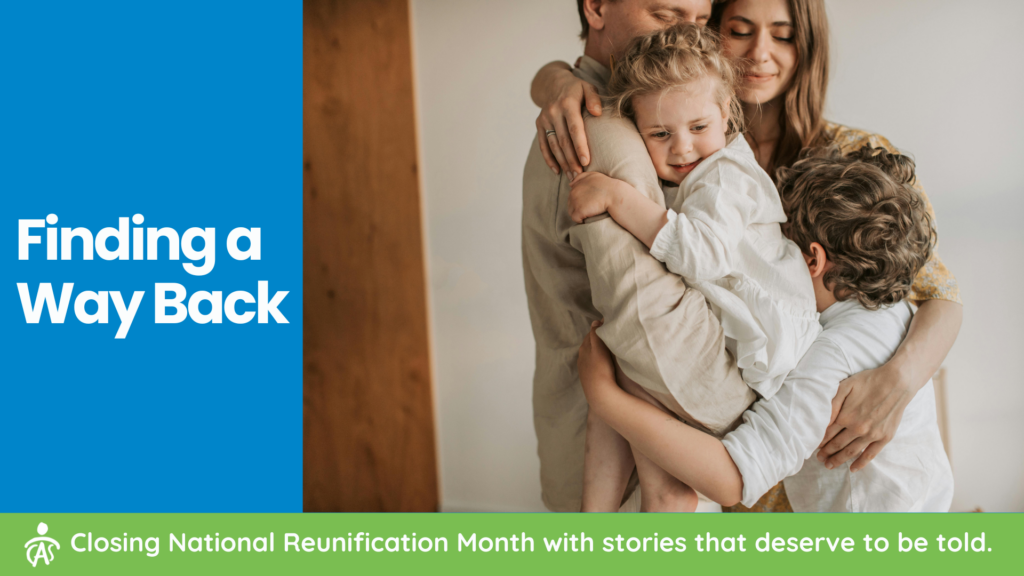
National Reunification Month ends today, but we want to make sure the work these families and our Family Partners team do not go unnoticed.
The Story We Tell Ourselves About Foster Care Can Be Very One-Sided
There is a narrative about foster care that most people carry without really thinking about it. It seeps in through evening news segments, television dramas and movies, and just about every comment section on a social media post that mentions a child or family involved “in the system.”
The story goes something like this: Foster care is where children go when their parents are beyond help. The parents are dangerous, or broken beyond repair, or simply absent in ways that have no explanation. The children enter a revolving door of placements and case numbers and court dates, and they don’t come out the other side. The kids are all deeply troubled, they age out and become nameless statistics destined for tragedy. It is a tale built on the most extreme cases that make headlines. A story illustrated by disturbing pictures painted with broad strokes. Here is what the data shows.
What the Numbers Say — Nationally
According to the Adoption and Foster Care Analysis and Reporting System (AFCARS), 331,747 children were in foster care in the United States as of September 30, 2025 significantly down from the all-time peak of 437,000 in 2017 and 2018. That downward trend is meaningful, driven in part by the Family First Prevention Services Act of 2018, which shifted federal investment toward keeping families together through substance abuse treatment, mental health services, and parenting support before a child is ever removed.
Here is the part the narrative gets wrong most often: nationally, neglect is the top reason children are removed from their homes, accounting for 55% of placement cases. Caretaker drug abuse accounts for 29%, and physical abuse for 13%. The stories that terrify and anger us; the ones that feel like the clearest justification for removal account for a minority of placements. The vast majority of families entering the child welfare system are not doing so because of violence. Neglect, more often than not, is a downstream consequence of poverty, addiction, untreated mental illness, and the absence of a strong support system.
Over half — 52% — of U.S. children who exited foster care in FY 2025 were reunited with their parents or lived with relatives. Reunification is, and remains, the most common outcome for children who enter care. That number could and should be higher. 30% of children who exited foster care in FY 2024 spent more than two years in care. Research is clear that the probability of reunification decreases the longer children are in foster care, with the greatest chance of reunification during the first four months of care. Every month that passes without meaningful intervention widens the distance between a parent and their child.
Wondering about those who do not reunify or somehow join a family through adoption? Over 15,000 youth aged out of foster care in FY 2025 without a family, a safety net, and with a weighty statistical probability that includes homelessness rates between 22% and 46% and college degree attainment of under 3%. Collectively, we must come to an understanding that we cannot afford to give up on families.
What Alabama’s Numbers Show
There are approximately 6,000 children in foster care in Alabama right now; and about 2,360 families serving as foster families in our state, the rest are in congregant care facilities. Further, while most children in the nation enter foster care due to neglect, in Alabama 46% enter care due to parental substance abuse. Alabama’s guiding philosophy, embedded in its child welfare policy, holds that children should be protected from abuse and neglect and, whenever possible, families should be preserved and strengthened in order to nurture and raise children in safe, healthy, and stable environments. This is a policy framework that shapes how DHR partners with community organizations like Children’s Aid Society of Alabama to serve these families; and it is the foundation our Family Partners program is built to support.
What Reunification Actually Requires
The gap between a family’s situation at the moment of removal and the hope for successful reunification is not one that closes on its own. It requires developing a plan with trusted partners and showing up consistently. Parents commit to whatever their specific plan entails. Engaging with substance abuse treatment, mental health services, parenting skill-building, employment support, and court compliance…often simultaneously, while also grieving their separation; often with a support system of zero. It requires sustained, non-judgmental, practical partnership that many parents in crisis have never had access to. That intensive intervention Family Partners provides.
CAS’s Family Partners program walks alongside parents who are working to create safe environments for their children. Family Partners team members become that trusted someone who helps guide a parent or couple through their reunification journey. They coach, they check-in when things get hard, and celebrate the wins. The cases our Family Partners carry are complex. A parent may be engaged with DHR, a Community Rehabilitation Organization, mental health services, and Family Court all at once. A Family Partner knows how those systems connect and how to build a human relationship rooted in belief that this parent, this family can make it.
The Stories That Deserve to Be Told
This month, we shared a few stories from Family Partners. You will meet a 37-year-old mom who completed a six-month mental health program in three months; a family with a unique struggle compounded by language barriers, and a mother who overcame her addiction and became a champion for others. These are the stories we hope you’ll carry as you talk about what foster care can actually do to strengthen families.
Children’s Aid Society of Alabama has been walking alongside Alabama’s children and families since 1912. To learn more about Family Partners, APAC, and all of CAS’s programs, visit childrensaid.org. Family Partners is made possible through a collaborative partnership between Children’s Aid Society of Alabama and Alabama DHR.
CAS, Marketing Communications Coordinator